
A great commercial sign company does far more than print a logo onto aluminum. It designs, engineers, permits, fabricates, and installs signage as a single accountable process, so a business owner or property manager ends up with a sign that is on-brand, code-compliant, and built to last.
The gap between that kind of partner and a generic vendor is the difference between a project that runs smoothly and one that stalls at the permit counter or fades within a season.
Whether you’re managing a commercial property, opening a new business, or coordinating signage across multiple locations, this guide explains what to look for in a commercial signage company before you commit to a project.
What Makes a Great Commercial Sign Company?
The strongest providers share a handful of traits. Use this as a quick checklist when you compare vendors:
- In-house fabrication so quality and timeline stay under one roof.
- Full-service capability, meaning design, engineering, permitting, fabrication, installation, and project management provided by one company.
- Licensed, insured installers who handle their work + specialty partners are used when required.
- Permitting expertise across multiple Southern California jurisdictions.
- A real, verifiable portfolio of completed commercial projects.
- Industry knowledge of codes, materials, and what lasts in the local climate.
- Clear communication and accountability from quote to final inspection.
The sections below explain why each of these is important, and what goes wrong when one is missing.
What Is In-House Sign Fabrication, and Why Does It Matter?
In-house fabrication means the company builds your signs in its own shop, with its own equipment and staff, rather than outsourcing the work to a third party. This single factor influences almost everything else: quality control, turnaround time, and accountability.
When a company controls fabrication, it can catch a flaw before installation, adjust a channel letter set or a monument sign to match a brand exactly, and keep its schedule on track instead of waiting on an outside vendor. When fabrication is outsourced, the company you hired becomes a middleman, and every revision and delay passes through an extra set of hands. For commercial projects with deadlines tied to a grand opening or a lease, that difference is significant.
What Services Should a Full-Service Sign Company Provide?
A full-service company manages the entire lifecycle of a sign, so you do not have to coordinate separately with a designer, a fabricator, a permit expediter, and an installer. A complete provider should offer:
- Design and brand development, translating your identity into signage that reads well at a distance
- Engineering and code review, so the sign is structurally sound and compliant
- Permitting, researched and submitted to the correct jurisdiction
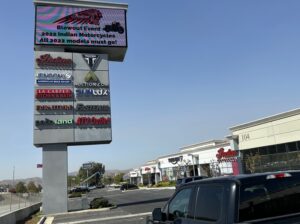
- Fabrication of interior and exterior signage, from custom business signs to large monument and pylon structures
- Installation by trained, insured crews
- Project management that keeps every stage coordinated and on schedule
- Maintenance and updates as your facility changes
When one accountable team owns all of these, the project moves faster and nothing falls through the cracks between vendors. The International Sign Association, the industry’s leading trade body, sets the professional standards that distinguish established sign companies from one-off shops, and full-service capability is central to them.
Why Is Sign Permitting So Important?
Permitting is where inexperienced vendors most often stumble, and the consequences land on you. Most exterior and illuminated commercial signs require a municipal permit before installation, and the rules differ from city to city. A sign installed without the right permit can be red-tagged, fined, or ordered down after you have already paid for it.
Southern California makes this especially demanding because a developer with sites in Corona, Anaheim, and Los Angeles County may face three different permitting processes for what appears to be the same sign. An experienced company knows each jurisdiction’s requirements, handles the paperwork, and builds permitting time into the schedule, so your project does not stall waiting on approvals nobody planned for.
Managing signage across several cities? Give us your locations, and we will tell you what each jurisdiction will require before you budget the project.
What Should You Look for in a Sign Installation Company?
Installation determines whether a beautifully fabricated sign actually performs. Look for crews that are licensed, insured, and employed by the company rather than subcontracted, because accountability matters most when a sign is going 20 feet up on a busy facade or being wired into building power.
Ask how the company handles access, electrical hookups, and traffic control on complex sites. Confirm that the team installing your sign is the same team that built it, since that continuity is what keeps the finished install matching the approved proof. A clean, safe, correct installation is the payoff for everything that came before it.
What Are the Benefits of Working With a Local Southern California Sign Company?
A local sign company brings advantages that a distant vendor cannot. It already knows the permitting offices in Riverside, Irvine, and the surrounding counties. It understands how intense the sun and heat across the Inland Empire affect materials and finishes. And it can respond quickly when a sign needs service, rather than scheduling a trip weeks out.
Local presence also means a verifiable track record you can actually go look at. You can see installed work in your region and talk to a team that understands the local businesses and buildings. For ongoing needs, from a single replacement to a multi-site rollout, that proximity turns a one-time vendor into a long-term partner. You can see the regions we cover on our areas we serve page.
How Do Commercial Sign Projects Work?
Most professional commercial sign projects follow a clear, managed sequence. Knowing it helps you spot a company that has done this many times before:
- Consultation and site survey to understand goals, brand, and conditions
- Design and proofing, refining concepts until they are approved
- Engineering and permitting, ensuring the sign is compliant and approved
- Fabrication in the shop, with quality checks along the way
- Installation by the company’s own crew
- Final inspection and handoff, confirming the sign meets code and matches the proof
A company that can walk you through this process confidently, with examples at each stage, is one that manages projects rather than improvising them. Our commercial development signage guide breaks down the full process in greater depth.
What Industries Need Commercial Signage?
Commercial signage serves nearly every sector, and the best companies understand the distinct needs of each:
- Retail centers and franchises need brand-consistent storefront and tenant signage
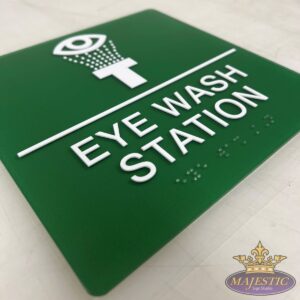
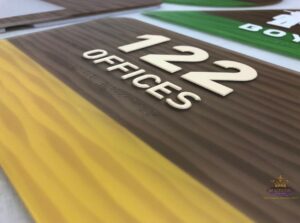
- Healthcare facilities require ADA-compliant signage and clear wayfinding
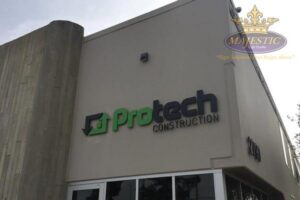
- Corporate offices invest in lobby logos and environmental branding
- Developers and property managers coordinate monument, directory, and multi-tenant signage
- Industrial and educational facilities need durable identification and safety signage
- General contractors rely on a signage partner who integrates cleanly into a build schedule
A company experienced across these sectors can anticipate requirements a generalist would miss, which is exactly what protects your timeline and budget.
How to Tell a Professional Provider From a Generic Vendor
The simplest test is to ask for specifics. A professional will show you a real portfolio of completed Southern California projects, name the jurisdictions they have permitted in, explain their materials rather than saying “aluminum” or “acrylic,” and describe how they manage a project end-to-end.
A case like our office rebranding across two states in 72 hours is the kind of proof point that separates an experienced partner from a vendor still learning on your project.
A generic provider, by contrast, tends to quote a lump sum with no breakdown, stay vague about permits, and subcontract the parts they cannot do themselves. The difference rarely shows up in the first quote. It shows up halfway through the project, which is exactly when it is most expensive to discover.
Why Businesses Across Southern California Choose Majestic Sign Studio
Choosing a commercial sign company is about more than finding someone who can produce a sign. It’s about partnering with a team that can manage design, permitting, fabrication, installation, and project coordination while keeping your project on schedule and aligned with your goals.
At Majestic Sign Studio, that’s exactly what we’ve been doing since 2012.
Over the past 14 years, we’ve completed more than 10,000 unique projects across Southern California, ranging from storefront signage and monument signs to ADA signage programs, vehicle fleets, environmental graphics, and multi-location branding initiatives. Our team brings more than 70+ years of combined experience in design, fabrication, permitting, project management, and installation, giving clients access to practical expertise built through thousands of real-world projects, not just theory.
Experience That Helps Avoid Costly Mistakes
Signage projects often run into problems long before installation begins. Permit requirements get overlooked, materials are selected without considering environmental conditions, or project timelines fail to account for local approval processes.
Having worked throughout Corona, Irvine, Anaheim, Riverside, Orange County, Los Angeles County, and the Inland Empire, we understand how local regulations and site conditions can impact a project’s success and help identify potential issues before they become costly delays.
In-House Capabilities and Accountability
Unlike companies that outsource major portions of the process, we manage design, printing, fabrication, and project coordination in-house. That control allows us to maintain quality standards, improve communication, and provide a single point of accountability from concept through installation.
Proven Results and Long-Term Partnerships
Our portfolio includes projects for organizations such as Amazon Fresh, Evolution Mechanical, Spring Street Courthouse, and Old Town Santa Ana. More importantly, many clients continue working with us as their signage needs grow because they trust our ability to deliver consistent results, clear communication, and reliable project execution.
After more than a decade in business and 10,000 completed projects, we’ve learned that great signage is about more than manufacturing signs. It’s about providing expertise, accountability, and solutions that help businesses move forward with confidence.
Frequently Asked Questions
What makes a good commercial sign company?
A good commercial sign company offers in-house fabrication, full-service capabilities, licensed installers, and permitting expertise, backed by a real portfolio. The strongest providers manage design, fabrication, permitting, and installation as one accountable process, which keeps quality high and timelines predictable across complex commercial projects.
How do I choose a commercial signage company?
Compare providers on in-house fabrication, full-service capability, licensed installation, and local permitting experience. Ask to see completed projects, confirm they handle their own installs, and request a detailed quote. A company that communicates clearly and explains its process is usually the one that will deliver reliably.
What is included in commercial sign project management?
Commercial sign project management covers the full lifecycle: consultation, design and proofing, engineering, permitting, fabrication, installation, and final inspection. A single accountable team coordinates each stage and the schedule, so the client is not managing separate designers, fabricators, and installers, reducing delays and errors.
Why does in-house fabrication matter?
In-house fabrication keeps quality control, timeline, and accountability under one roof. The company can catch issues before installation, make precise brand adjustments, and avoid the delays that come from outsourcing to a third party, which matters most on deadline-driven commercial projects.
What industries need commercial signage the most?
Retail centers, healthcare facilities, corporate offices, developers, property managers, industrial businesses, and educational institutions all rely on commercial signage. Each has distinct needs, from ADA wayfinding in healthcare to multi-tenant directories for developers, so experience across sectors is a meaningful advantage in a sign company.
Also Read: Top Signage Trends to Watch in 2026: What Business Owners in Southern California Should Know
Choosing the Right Partner for Your Next Project
The best commercial sign company is the one that takes ownership of the whole process, from the first design sketch to the final inspection, and stands behind the result.
For businesses, developers, and property managers across Corona, Orange County, Riverside County, and Southern California, that combination of in-house fabrication, full-service capabilities, and local expertise turns signage from a risk into an asset.
If you are planning a project and want a partner who will get the details right, our team is glad to walk your site and map out what a professional program for your space looks like.