
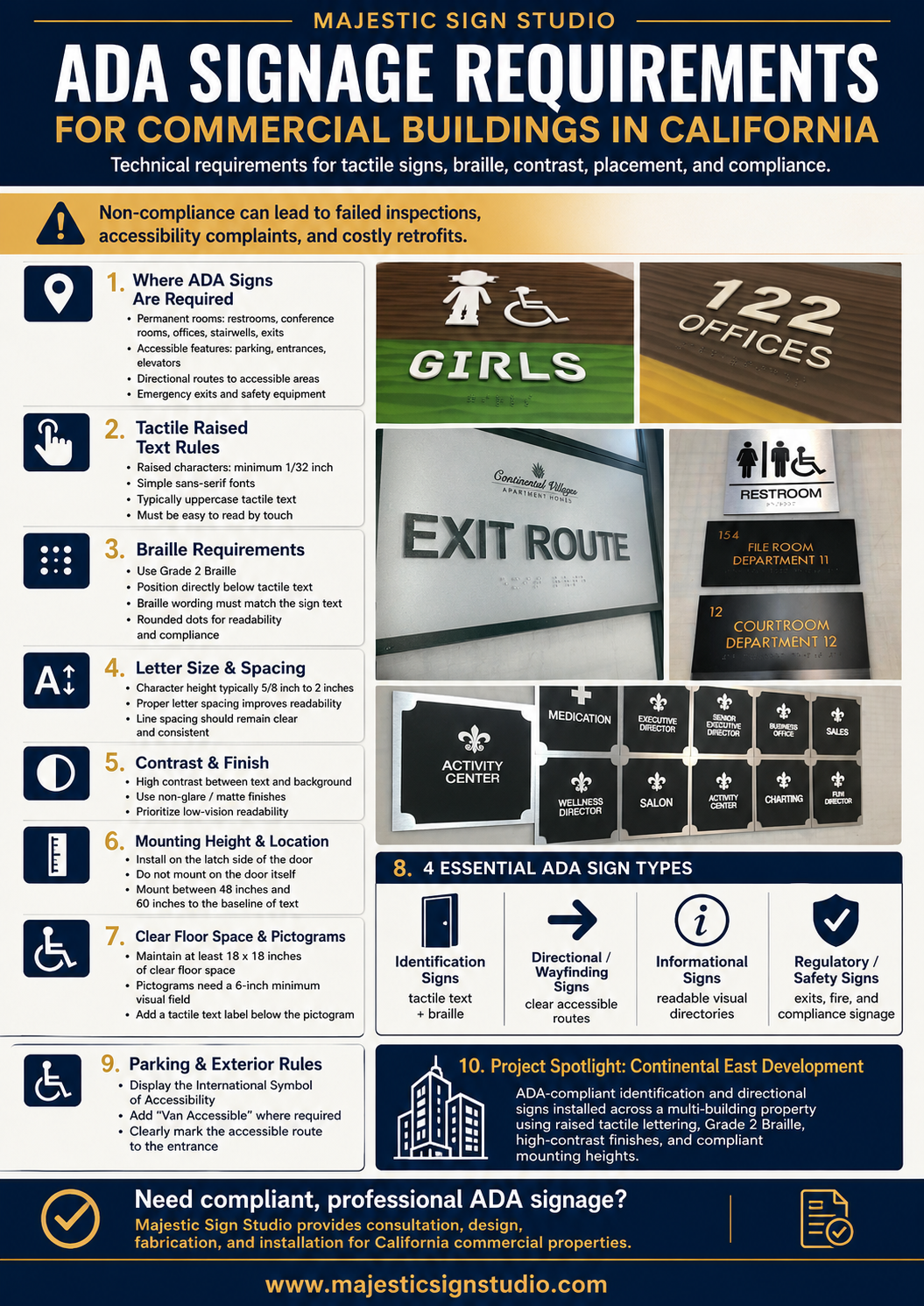
For ADA signage in commercial buildings in California, one must comply with both the Americans with Disabilities Act (ADA) and the California Building Codes (CBC). For facility managers and business owners, the specific requirements for tactile signs, braille, and placement are not optional.
Non-compliance leads to failed inspections, accessibility lawsuits, and costly retrofits. The rules apply to any permanent room or space: restrooms, stairwells, exits, conference rooms, and accessible parking.
Below are the technical requirements for ADA signage in California commercial buildings, including mounting height, contrast, braille standards, and location mandates.
Where You Must Put ADA Signs in Your Building
You don’t need to put Braille on your breakroom fridge. But you do need it in any room that is permanent. If the space doesn’t move, it likely needs a sign.
Here is where you need to pay attention:
- Permanent rooms: Restrooms, conference rooms, offices, stairwells, and exits.
- Accessible features: Parking spaces, building entrances, and elevators.
- Directional routes: Any hallway or wall telling you how to get to an accessible area.
- Emergency exits and safety equipment.
The key idea is simple. If you walked into a building and needed to find the bathroom or a staircase, the sign should be there. If a space doesn’t change often, it needs ADA-compliant office signage.
Rules for Tactile Raised Text You Must Follow
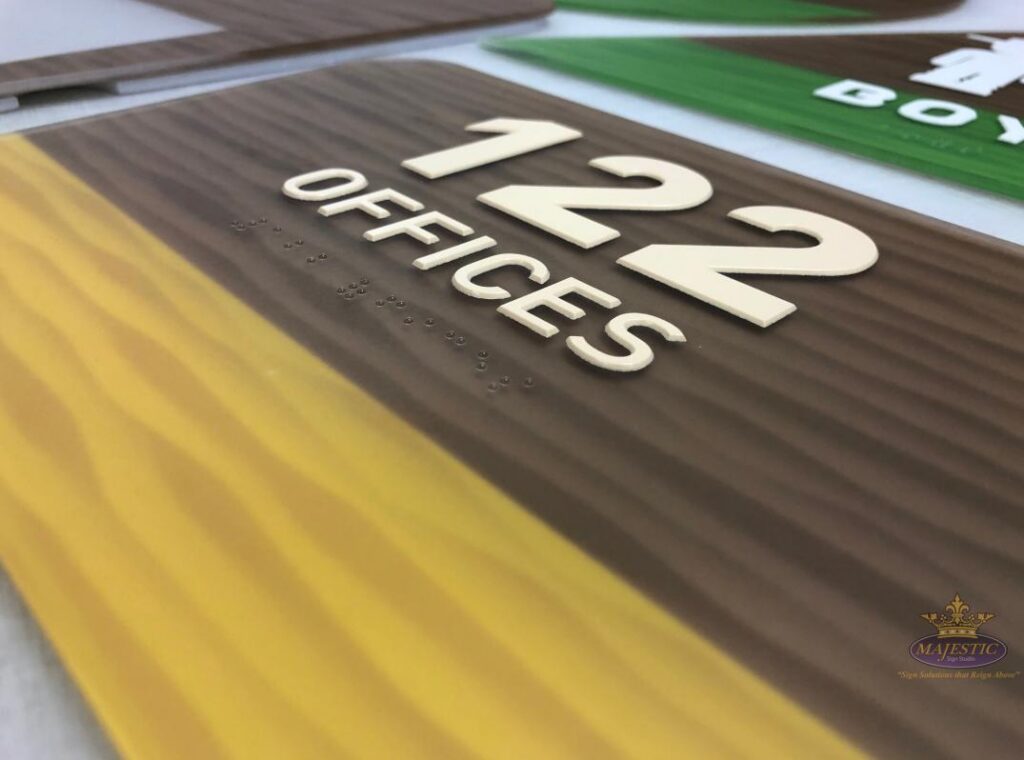
This is the stuff you can feel. For any sign that identifies a permanent room (like “Conference Room A” or “Restroom”), the letters cannot just be printed on the surface. They have to be physically raised.
Here are the technical specs we follow daily:
- Height: Characters must be raised at least 1/32 of an inch off the background.
- Font: You must use simple sans-serif fonts. No fancy script or thin lines.
- Case: Typically, all uppercase letters are used for the tactile part.
The goal here is touch. Someone running their fingers across the sign needs to read the room name clearly. If the font is too fancy, they can’t tell an “O” from a “Q.”
What You Need to Know About Braille Rules
Right below those raised letters, you need Grade 2 Braille. This is the contracted version of Braille (like shorthand for your fingers).
A few hard rules we check every time:
- The Braille must be positioned directly below the tactile text.
- It must match the wording exactly. If the sign says “Rm 201,” the Braille cannot just say “Room.”
- The dots must be rounded. Sharp dots hurt to read and don’t pass inspection.
Size and Spacing Rules for Letters on Signs
We hear this question a lot: “How big do the letters need to be?”
For ADA-compliant room signs in Orange County and throughout California, the required character height typically ranges from 5/8 inch to 2 inches.
Spacing matters just as much as size.
- Letter spacing: About 10% to 35% of the character height.
- Line spacing: About 135% to 170% of the character height.
If letters are smashed together, no one can read them from a distance.
Contrast and Readability Matter a Lot Here
This rule is for people with low vision who aren’t blind. They need to see the difference between the letter and the wall behind it.
You need high contrast. Think dark letters on a light background, or light letters on a dark background. We usually aim for about a 70% difference.
Also, you need a non-glare finish. If you put a shiny plastic sign under fluorescent lights, the glare makes it invisible. We use matte finishes to keep it readable.
Where and How High to Mount Your Signs
This is where we see the most mistakes on job sites. You have the perfect sign, but you put it in the wrong spot.
Here is the rule:
- Mount the sign on the latch side of the door. That is the side where the door handle is.
- Never mount it on the door itself. Doors move. Signs need to stay still.
- The mounting height must be between 48 inches and 60 inches from the floor to the baseline of the text.
Why? So a person in a wheelchair can roll up and touch the Braille without straining.
Clear Floor Space in Front of Every Sign
You cannot put a trash can, a plant, or a fire extinguisher in front of an ADA sign.
You need at least 18 inches by 18 inches of clear floor space in front of the sign. This allows a wheelchair user to approach straight on and read the tactile text. If they have to reach over something, the sign fails.
Rules for Pictograms on Signs You Install
If you use a little picture (like the male/female bathroom icons or the wheelchair symbol), you have to follow the rules for those, too.
- The pictogram needs a 6-inch minimum visual field around it.
- You must have a text description below the pictogram explaining what it is.
So, if you put up a restroom sign with the little man icon, the word “Men” must be directly below it in tactile text and Braille.
Four Types of ADA Signs Your Building Needs
Not all signs are created equal. You need different levels of compliance depending on what the sign does.
Identification Signs Are the Most Strict
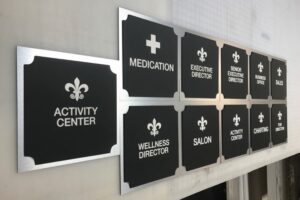
These are room labels. “Restroom,” “Conference Room,” “Office 305.” These must have tactile text + Braille.
Directional and Wayfinding Signs
These guide you to accessible routes. Think “To Elevator” with an arrow. These need to be visually clear, but they do not always require tactile Braille.
Informational Signs Like Directories
Building directories or hours of operation. Just need visual accessibility (good contrast, readable font).
Regulatory and Safety Signs
Exit signs and fire safety instructions. These need to follow the contrast rules but often have specific state fire marshal requirements too.
Parking and Exterior Signage Rules You Need
Your job isn’t done when you walk through the front door. Your parking lot counts too.
ADA signs, Orange County businesses need to watch for this specifically because parking violations are a huge target for lawsuits.
You must display:
- The International Symbol of Accessibility (the blue and white wheelchair icon).
- Van-accessible signage where applicable (this usually requires an extra tag that says “Van Accessible”).
You also need to clearly mark the accessible route from the parking space to the entrance. If a van user parks but has to roll through a dirt patch to get to your door, that is a problem.
Real-World Project Spotlight: Continental East Development ADA Installation
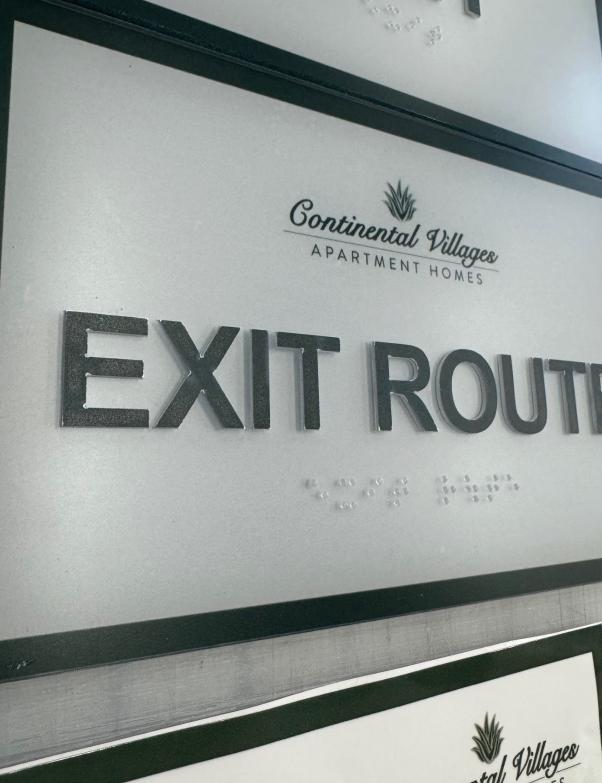
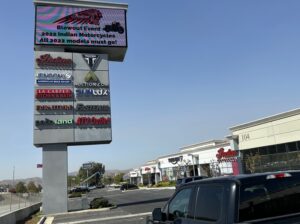
This project for Continental East Development involved installing ADA-compliant signage across a multi-building property, including directional and identification signs with raised tactile lettering and Grade 2 Braille.
All signage was fabricated with high-contrast finishes and installed at ADA-compliant mounting heights to meet both ADA Standards and California Building Code (CBC) requirements.
A key challenge in this type of development is balancing tenant branding with strict accessibility compliance, while ensuring everything passes inspection without rework. This installation reflects practical, on-site experience delivering compliant signage systems for large-scale properties in California.
Why Choose Majestic Sign Studio for Your ADA Signs
Majestic Sign Studio provides ADA signage for commercial buildings in California with full in-house service: consultation, design, permitting, fabrication, and installation.
What we deliver:
- Full-service under one roof: No coordination between multiple vendors for tactile signs and braille plaques.
- Verified fabrication standards: Every raised character height, braille dot placement, and mounting spec is checked against the 2010 ADA Standards.
- Commercial-grade materials: Non-yellowing acrylics and fade-resistant finishes rated for California sun, daily cleaning, and repeated touching.
- Permitting handled: City code compliance and inspection requirements for restroom signs, exit markers, and room identifiers are managed by our team.
- Technical support from owners: Gordy and Denise Wolfe answer mounting height, font, and braille questions directly. No phone trees.
Your Next Step Is Simple and Easy
You don’t need to become an ADA expert. That is our job.
Don’t wait for a complaint to land on your desk. Fixing signage now is faster and a lot less stressful than dealing with a violation later.
With our years of experience installing California ADA signage requirements across the state, we have learned that the best approach is simple: Do it right once. Use the right materials. Mount it at the right height. Get the contrast right.
Contact Majestic Sign Studio today to schedule a signage consultation. Let’s get your building compliant and professional, from the parking lot to the top floor.
Must Read Articles: