


The fire extinguishers in your building get inspected every year. The elevator gets inspected every year. The ADA signs identifying every permanent room have probably not been touched since the day they went up, and federal law cares about all three.
ADA signage for commercial properties is one of the easiest compliance failures to ignore and one of the easiest for a plaintiff’s attorney to prove. Most commercial buildings currently have at least one violation. This guide covers which signs in your building must legally meet the ADA Standards for Accessible Design, the technical specs each must meet, and the most common compliance gaps in multi-tenant properties along the 91 Corridor.
What Does ADA Require for Commercial Property Signage?
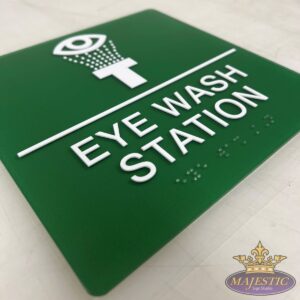
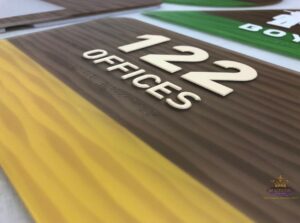
ADA compliant signs must include tactile raised characters, Grade 2 braille, non-glare finishes, and high-contrast color combinations on every sign that identifies a permanent room or space. The U.S. Access Board’s Chapter 7 guidelines define the full technical standard.
Raised characters must be uppercase, sans serif, between 5/8 inch and 2 inches tall, raised 1/32 inch minimum from the surface. Grade 2 braille sits 3/8 inch below the lowest character. The sign mounts on the latch side of the door, with the lowest tactile character baseline between 48 and 60 inches from the finished floor.
Temporary signs, directional-only signs, and company logos do not need tactile features. The moment a sign identifies a permanent room, compliance is mandatory.
Where Must ADA Signs Be Installed in Commercial Buildings?
Every permanent room and space requires ADA-compliant identification signage. That includes offices, restrooms, stairwells, elevators, and exits. Missing one location creates liability.
Required locations include:
- Restrooms and ADA bathroom signs with gender identification and accessibility pictograms
- Stairwell signs identifying the floor level on every landing
- Elevator jamb signs with raised floor numbers and braille
- Exit signs in areas of refuge
- Identification signs at every tenant suite, conference room, and common area
Multi-tenant buildings along the 91 Corridor, from Corona through Riverside, often have 30 to 50 permanent rooms requiring compliant signs. When a building changes tenants, new suite signs must meet current standards even if the previous ones did not.
ADA Signage Compliance Checklist for Property Managers
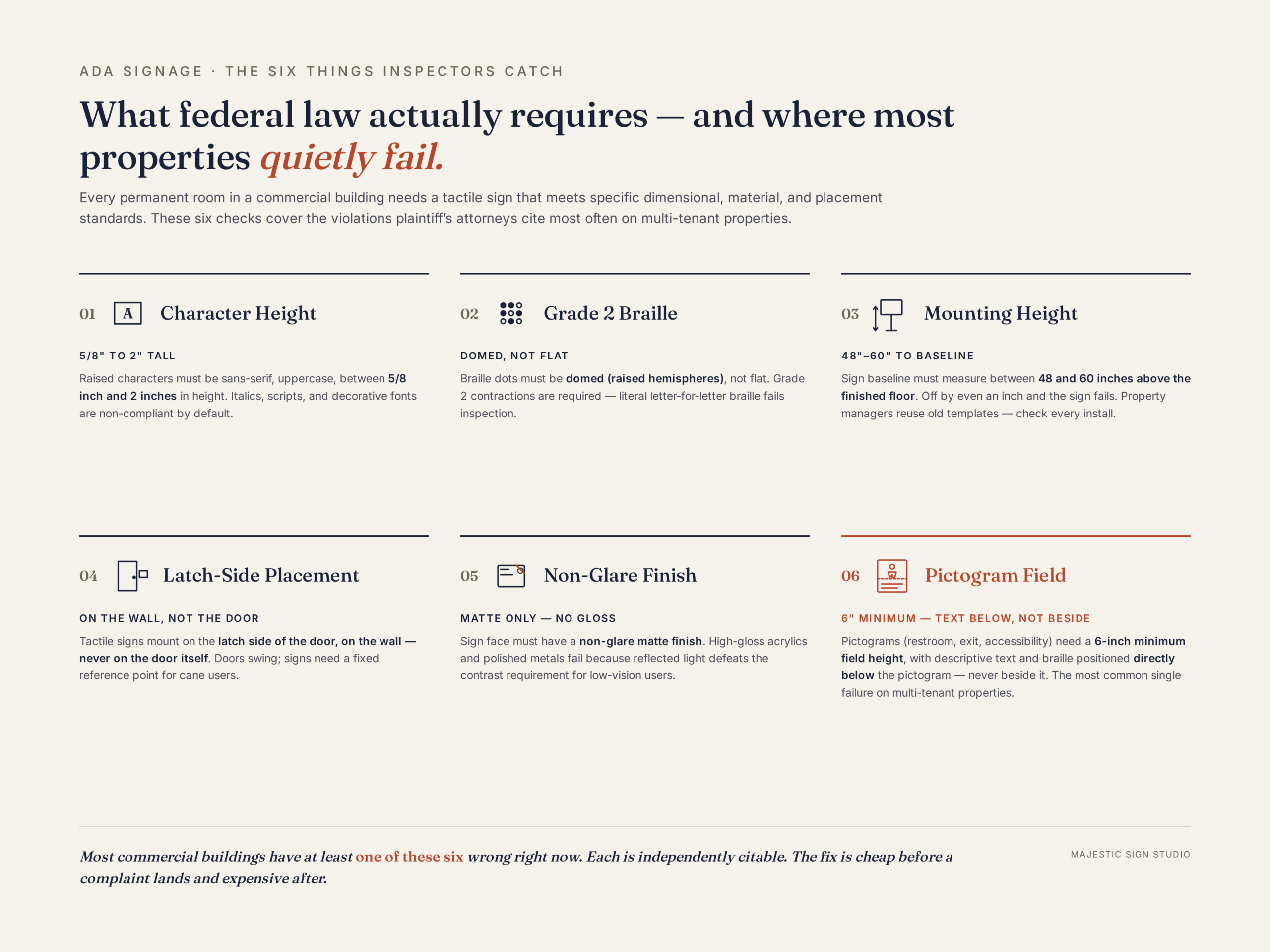
Walk the building with this checklist before your next inspection or tenant turnover.
How Do Wayfinding Systems Reduce Risk in Multi-Tenant Buildings?
A coordinated wayfinding system reduces ADA risk by applying the same compliance standard to every directional sign, directory, and room identifier across the property. That eliminates the patchwork that accumulates from years of tenant turnover.
A well-planned indoor signage and wayfinding program covers lobby directories, decision-point directional signs, and room ID signs at every door. Buildings on the 91 Corridor that complete a unified sign audit before tenant turnover spend less on emergency remediation than those that address signs one at a time.

What Materials Keep ADA Signs Compliant for Years?
In the Inland Empire, where summer temperatures regularly exceed 100 degrees for months, material selection determines whether a sign remains compliant or becomes a violation.
Photopolymer is the most common material for ADA signs because it produces precise raised characters and clean braille dots in controlled interior environments.
Acrylic with subsurface printing offers a premium look. Raised characters sit on the surface while background color sits behind a clear face panel, protecting the finish from wear.
Brushed aluminum with applied tactile elements performs well in high-traffic environments like healthcare signage, where signs are subject to constant contact and disinfectant cleaning.
The wrong material leads to fading, peeling, or braille dots wearing flat. A degraded sign no longer meets the raised character standard.
What Happens When Commercial Properties Fail an ADA Inspection?
ADA signage violations can trigger Department of Justice complaints, private lawsuits under Title III, and remediation costs that dwarf the original price of compliant signage. First-time federal violations carry penalties up to $75,000. Subsequent violations reach $150,000.
Once a complaint lands, owners face a fixed remediation window. Ordering, fabricating, and installing compliant signs across an entire building on a compressed timeline costs significantly more than a planned program. Signage is one of the easiest violations to photograph. A missing braille line or a sign at 46 inches instead of 48 is a clear, measurable deficiency.
Talk to Majestic Sign Studio About ADA Compliance
Majestic Sign Studio audits commercial properties across Corona, Riverside, and the 91 Corridor. We measure every existing ADA sign against the 2010 Standards, flag mounting-height and braille violations, and replace non-compliant signs in a single fabrication run.
Schedule a Consultation today!
Questions Property Managers Ask About ADA Signs
What is the correct mounting height for ADA signs?
The baseline of the lowest tactile character must be 48 inches minimum from the finished floor, and the highest character baseline must be 60 inches maximum. Mount on the latch side of the door.
Are directional signs required to have Braille?
Directional and wayfinding signs do not require tactile characters or braille. They must use high-contrast text with a non-glare finish. Only signs that identify a permanent room or space require full tactile and braille treatment.
How often should ADA signs be inspected?
No mandated interval exists, but best practice for commercial properties is an annual walk-through. Check for faded contrast, damaged braille dots, incorrect mounting heights, and missing signs in spaces that changed use.
What ADA sign violations are most common?
Missing braille, incorrect mounting height, signs on the wrong side of the door, faded contrast, and missing signs on rooms added or renovated after the original sign package was installed.
Do tenant improvements trigger new ADA sign requirements?
Yes. When a space is renovated or room use changes, the new configuration must meet current standards. A suite divided into three rooms needs three separate compliant identification signs.
Can property managers be held liable for ADA sign violations?
Property owners and managers both face liability under ADA Title III. Responsibility falls on whoever controls common areas and building infrastructure, which in most commercial leases is the property manager or owner.
Bonus Articles:
- ADA Signage Placement Guide for Offices, Medical Buildings & Retail Centers
- Interior and Exterior Signage for Commercial Developments: A Complete Guide